Morocco, the Way I Love to Tell It
The First People: the Amazigh
Long before anyone else arrived, Morocco belonged to the Amazigh, the people many of you know as Berbers (a word that comes from the Greek “barbaros”, a name given by outsiders). Amazigh is usually translated as “free people” or “noble people”, and I think that says everything. They have lived in these mountains and deserts for thousands of years. Their language, Tamazight, has its own ancient alphabet, Tifinagh, revived in a modern form that Morocco adopted in 2003. Since the 2011 constitution, Tamazight has been an official language of Morocco alongside Arabic, so look for those curious symbols on road signs and public buildings. The rugs, the silver jewellery, the couscous on Friday: so much of what you will love here is Amazigh.
When Rome Came to Morocco
On Day 4 we walk through Volubilis, and every time I am amazed. It began as an Amazigh town of the Kingdom of Mauretania, around the 3rd century BC, and was one of its capitals under King Juba II before Rome annexed it in the year 40. At its peak, around the late 2nd century, about 20,000 people lived here from olive oil and wheat. You will see the triumphal Arch of Caracalla (217 AD), columns still standing, and floor mosaics that kept their colours for centuries: the Labours of Hercules, Bacchus, Orpheus and his dolphins. When Rome pulled back around the year 285, people kept living here for centuries, and in 788 it was here that Idris I was welcomed. Since 1997 it has been a UNESCO World Heritage Site, and on a quiet morning you can almost hear the market.
Sultans, Dynasties and Marrakech
In 788, Idris I, a descendant of the Prophet Muhammad fleeing the East, arrived at Volubilis, where the Amazigh Awraba tribe chose him as their leader. The Idrisid dynasty he founded is widely seen as the first Moroccan Islamic state, and great dynasties have followed one another ever since. Around 1070 (some sources say 1062), the Almoravids founded Marrakech and made it their capital. For centuries foreigners called the whole kingdom by the name of that capital, and that is where “Morocco” comes from: Spanish Marruecos, French Maroc, English Morocco, all from Marrakech (Murrakush). The meaning of the city’s name is still debated, but the most accepted explanation is the Amazigh amur n akush, often translated as “land of God”. In Persian and Urdu the country is still called Marrakesh, while in Arabic Moroccans say al-Maghrib, “the West”, the land where the sun sets (historically al-Maghrib al-Aqsa, “the Farthest West”). The next dynasty, the Almohads, began the Koutoubia mosque in 1147; its minaret, about 77 metres tall and finished around 1195, takes its name from the booksellers (kutubiyyin) who once gathered at its feet, and you will see it from almost everywhere in the city. The family ruling today, the Alaouites, came from the Tafilalt, the region we cross near Merzouga, and has reigned over Morocco since the 1660s; the title changed from Sultan to King in 1957. The Bahia Palace we visit on Day 10 was begun in the 1860s by the grand vizier Si Moussa and greatly enlarged in the 1890s by his son Ba Ahmed, grand vizier to the young sultan.
Chefchaouen and the Andalusian Heart
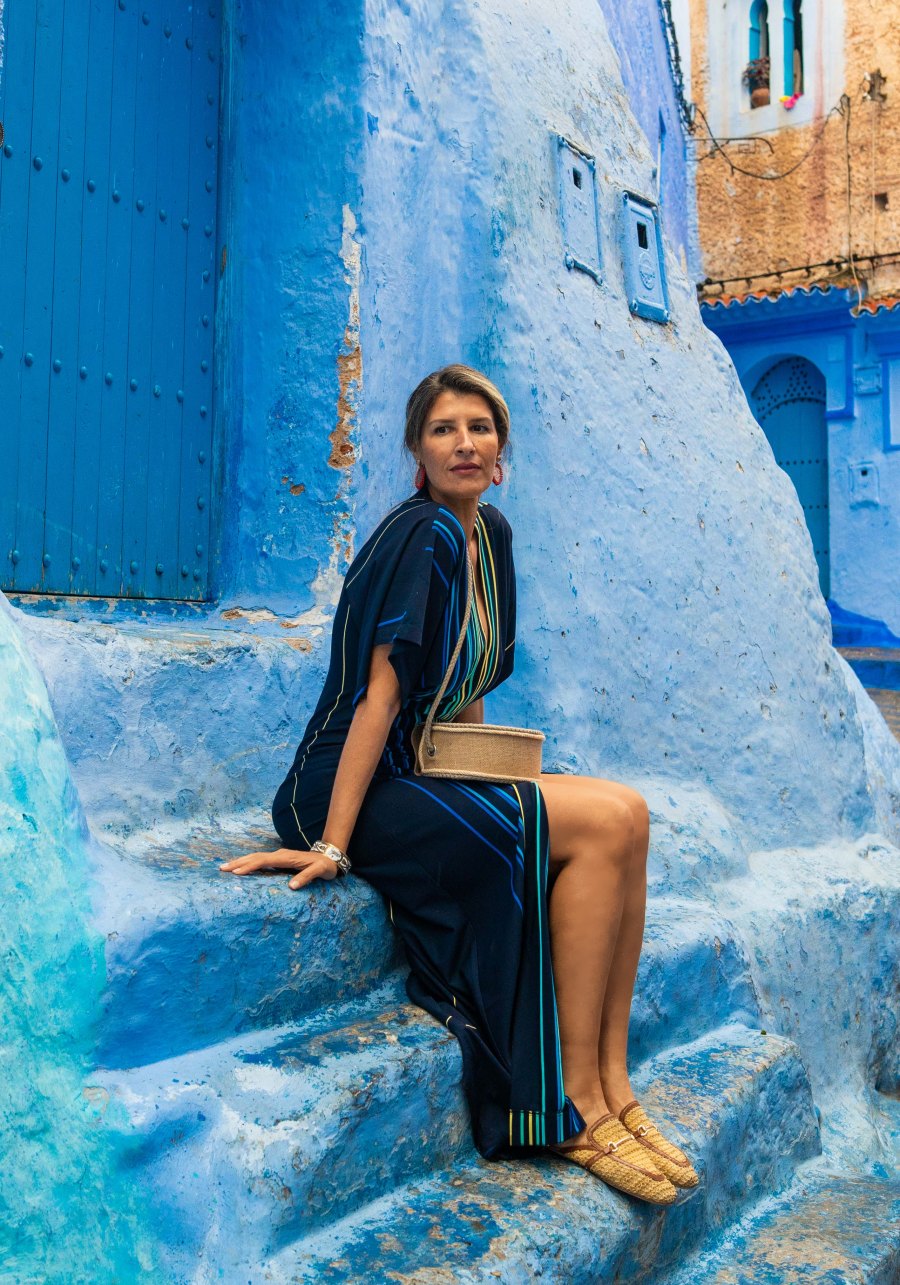
Chefchaouen was founded in 1471 by Moulay Ali ibn Rashid as a mountain fortress against the Portuguese. After 1492, many Muslim and Jewish families forced out of Spain found refuge here. They brought Andalusian gardens, tiled fountains and a gentle way of life you still feel in the lanes. And the blue? Old photographs show a mostly white town, and the blue spread mainly from the 1930s. It is most often linked to the Jewish families of the town, for whom blue recalls the sky and the divine. Locals will also tell you it keeps the houses cool or keeps mosquitoes away, lovely beliefs even if they are not proven. Every story has its charm, so I simply invite you to keep the one that speaks to your heart, and let the blue streets tell you the rest. Our home for two nights is Riad Torre Hadra, a family house passed down for generations, from great-grandparents to grandparents, to Hamid El Hadri, the beloved Chefchaouen-born singer who opened its doors as a riad. Hamid has spent his life carrying Andalusian and Moroccan heritage through his music, and his latest album is called, fittingly, Jodour (Roots). I have stayed there three times: the energy is simply positive, and Hamid is a beautiful soul. For us, a journey is not only about places, but about the people who carry the heritage and values of their ancestors.
Riads and Palaces: Behind the Plain Door
Walk through a medina and you will see only high, plain walls and heavy wooden doors. Then one opens, and you step into paradise. That is a riad. The word comes from the Arabic riyad, “gardens”: a true riad is built around a planted courtyard, often divided into four parts around a fountain, with orange trees and the sky as its ceiling. The house turns its back to the noisy street, and a bent entrance corridor keeps passers-by from seeing inside. Rooms open onto the courtyard and only rarely outward, so the family lives in privacy, light and coolness. Look closely at the craft: zellige mosaics cut piece by piece by hand, carved cedar ceilings, lace-like plaster, and tadelakt, the silky, waterproof polished lime walls of Marrakech. A palace is the same dream at royal scale: courtyard after courtyard, gardens, painted ceilings and rooms for every season. At the Bahia Palace on Day 10, whose name means “the brilliant”, notice how each courtyard feels like a secret revealed only to those who are welcome.
Caravans, Kasbahs and the Sahara
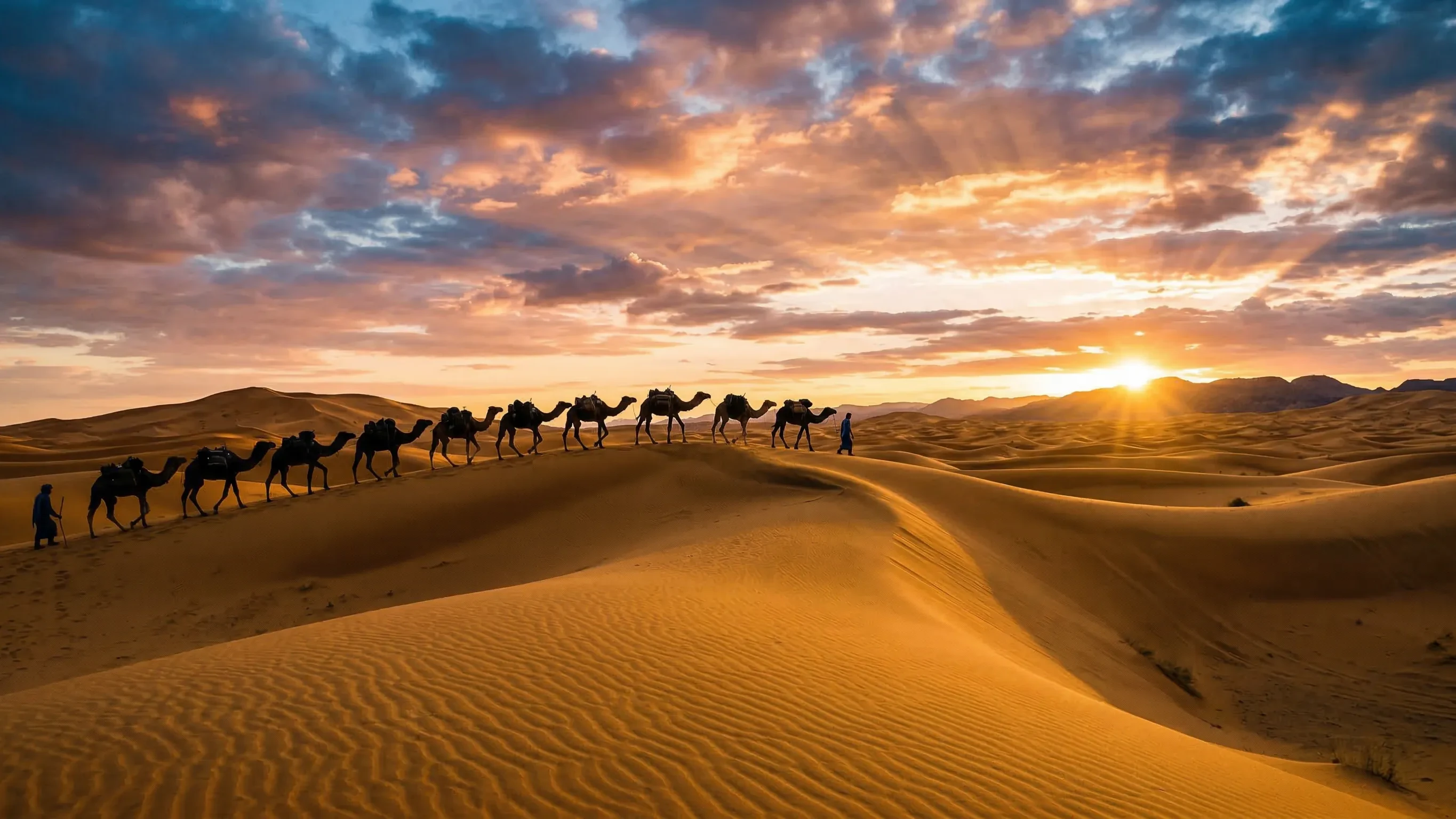
Near Merzouga, at Rissani, lie the ruins of Sijilmassa, founded in 757 and once one of the great caravan towns of Africa. From here, camel caravans crossed the Sahara to Timbuktu, a journey that often took two months or more (a famous sign in Zagora still reads “Timbuktu 52 days”), trading salt, cloth, copper and books for West African gold. The kasbahs you will see on Days 7 and 8 are fortified homes and villages of rammed earth mixed with straw, which is why they glow red and ochre at sunset. Ait Ben Haddou, a UNESCO World Heritage Site since 1987, stood on the old caravan route between the Sahara and Marrakech, and most of its buildings date from the 17th century. It is so beautiful that filmmakers keep coming back: Lawrence of Arabia, Gladiator and Game of Thrones were all filmed around Ouarzazate.
The Hammam: Steam, Black Soap and Rebirth
For centuries, every Moroccan neighbourhood has been built around five things: the mosque, the fountain, the Quranic school, the communal bread oven and the hammam. The hammam is far more than a bath. It is where women and men, at separate times or in separate rooms, traditionally come once a week to wash, talk, laugh and share news; it is even said that mothers used to spot a future bride for their son there. You move slowly from a warm room to a hot one, the steam opening every pore. Then comes the ritual: savon beldi, a black soap made from olives, is spread on the skin and left to soften it, before a kessa glove scrubs away what feels like a whole year of tiredness. Some finish with ghassoul, a mineral clay from the Middle Atlas, and a rinse of rose or orange blossom water. You walk out lighter, glowing and strangely at peace. On our free day in Marrakech (Day 11) you can choose an optional hammam and massage, and I promise you will sleep like a baby that night.
The Moroccan Table
Moroccan cooking is a love story between the Amazigh, Arab, Andalusian, Jewish and African worlds, and you taste all of them in one meal. The tagine is named after the clay pot with its pointed lid, which sends the steam back down so the meat melts slowly with prunes and almonds, or with preserved lemon and olives. Couscous, rolled by hand and steamed above a stew, is the Friday family meal, and in 2020 UNESCO added it to its list of intangible heritage, jointly for Morocco, Algeria, Tunisia and Mauritania. Pastilla is pure magic: thin pastry traditionally filled with pigeon, today often chicken (there are seafood versions too), with almonds and spices, finished with cinnamon and sugar, sweet and savoury at once. Harira, a tomato, lentil and chickpea soup, warms every Ramadan evening. In Marrakech, men make tanjia, beef or lamb slowly cooked for hours in a clay jar tucked into the embers of the hammam furnace. Everything is perfumed with ras el hanout, which means “head of the shop”: the spice merchant’s finest blend, a dozen spices or more, sometimes over thirty. In the desert, ask about madfouna, the stuffed “Berber pizza” baked in the embers of a wood fire, and in the morning look for msemen, flaky square pancakes with honey and amlou. Eat slowly, with bread as your spoon. That is the Moroccan way.
A Cooking Class at Lalla Zehra
In Moroccan homes, recipes are traditionally passed on by hand rather than written down. They travel from grandmother to mother to daughter, by smell, by a pinch of this and a handful of that. Lalla is the respectful title Moroccans give to a lady, and our optional cooking class at Lalla Zehra in Marrakech (Day 12) is a chance to step into that tradition. Sleeves rolled up, you learn the gestures behind the dishes you have been tasting all trip: how to layer a tagine so nothing burns, how spices are balanced, how bread is kneaded, and how mint tea is poured from high for that perfect foam. Then comes the best part: sitting down together to eat what you made. You leave with recipes, yes, but above all with a memory you can recreate in your own kitchen, so that one evening back home, the smell of cumin and saffron brings you straight back to Marrakech.
Essaouira and the Argan Tree
Essaouira was long known to Europeans as Mogador, a name probably from the Phoenician word for a small fortress. From the 1760s, Sultan Mohammed ben Abdallah rebuilt it as a planned port town to trade with Europe, with ramparts designed by the French engineer Théodore Cornut. Its Arabic name comes from the word for wall, roughly “the little rampart”. Its medina has been a UNESCO World Heritage Site since 2001, and the ocean wind keeps it fresh all year. On the drive there, look for the argan trees: they grow naturally almost only in southwestern Morocco. Women’s cooperatives crack the nuts by hand to make argan oil, and if you are lucky you may even see goats standing in the branches.
Mint Tea and Moroccan Hospitality
If there is one thing I want you to feel, it is the welcome. In Morocco, a guest is a gift. You will be offered mint tea everywhere: green tea, fresh spearmint and sugar, poured from high above the glass so it makes a little foam. Green tea reached Morocco in the 18th century (legend says as a gift from Queen Anne of England to Sultan Moulay Ismail), but it truly spread to every home in the mid-1800s, when British merchants, cut off from other markets by the Crimean War, sent their tea to Moroccan ports. Pouring from high is a sign of respect and skill. Accept the glass with a smile, even if you only take a sip. Bread is shared from one basket and meals are slow. Here, time spent together is never wasted.
Casablanca on Screen & Rick’s Café
Casablanca, with Humphrey Bogart and Ingrid Bergman, premiered in New York in November 1942 and is one of the most loved films ever made. Rick runs a nightclub where refugees wait for papers to escape the war, and he must choose between the woman he loves and doing what is right. It won three Oscars, for Best Picture, Best Director and Best Screenplay, and gave us “Here’s looking at you, kid”, “We’ll always have Paris” and the song As Time Goes By. The funny part: it was filmed entirely in California, in the Warner Bros. studios, and Rick’s Café never existed until 2004, when a former American diplomat opened one in an old mansion by the medina walls. With a pianist playing As Time Goes By, an optional dinner there is a perfect night out.